01Key Concepts & Definitions
Inverse of a Function: The inverse of a function , denoted by , exists only if is a bijective function (both one-one and onto). If such that is one-one and onto, we can define a unique function such that . Here, the domain of is the range of , and the range of is the domain of . Also, .
Trigonometric Functions and Bijections: Standard trigonometric functions are not one-one and onto over their natural domains. To ensure the existence of their inverses, their domains and ranges must be restricted so that they become bijective.
Principal Value Branch: When restricting the domains of trigonometric functions to make them bijective, infinitely many intervals are possible. The standard, universally accepted restricted interval is called the principal value branch. The value of an inverse trigonometric function that lies in its principal value branch is known as its principal value.
Notation Convention: denotes the inverse sine function (arc sine function). JEE Tip Do not confuse with . The latter means , which is . The notation using as a superscript for inverse was suggested by astronomer Sir John F.W. Herschel in 1813.
Historical Context: The study of trigonometry originated in India with mathematicians like Aryabhata, Brahmagupta, Bhaskara I, and Bhaskara II. Thales is credited with early height and distance calculations using shadows.
02Domain, Range & Principal Value Branches
The following table dictates the strictly defined domains and ranges (principal value branches) of inverse trigonometric functions. JEE Tip Memorize this table perfectly; nearly all JEE Advanced range and domain restriction questions stem from here.
| Function | Domain | Range (Principal Value Branch) |
|---|---|---|
| or | ||
| or | ||
03Important Graphs & Graphical Transformations
General Transformation: The graph of an inverse function can be obtained from the graph of the original function by interchanging the and axes. Visually, this is the mirror image (reflection) of the original graph along the line .
Graphs of Inverse Trigonometric Functions
- : Domain , strictly increasing from to . Point of inflection at origin.
- : Domain , strictly decreasing from to . Crosses y-axis at .
- : Domain , strictly increasing. Horizontal asymptotes at and . Passes through origin.
- : Domain , strictly decreasing. Horizontal asymptotes at and . Crosses y-axis at .
- : Domain . Increasing in and . Horizontal asymptote at .
- : Domain . Decreasing in and . Horizontal asymptote at .
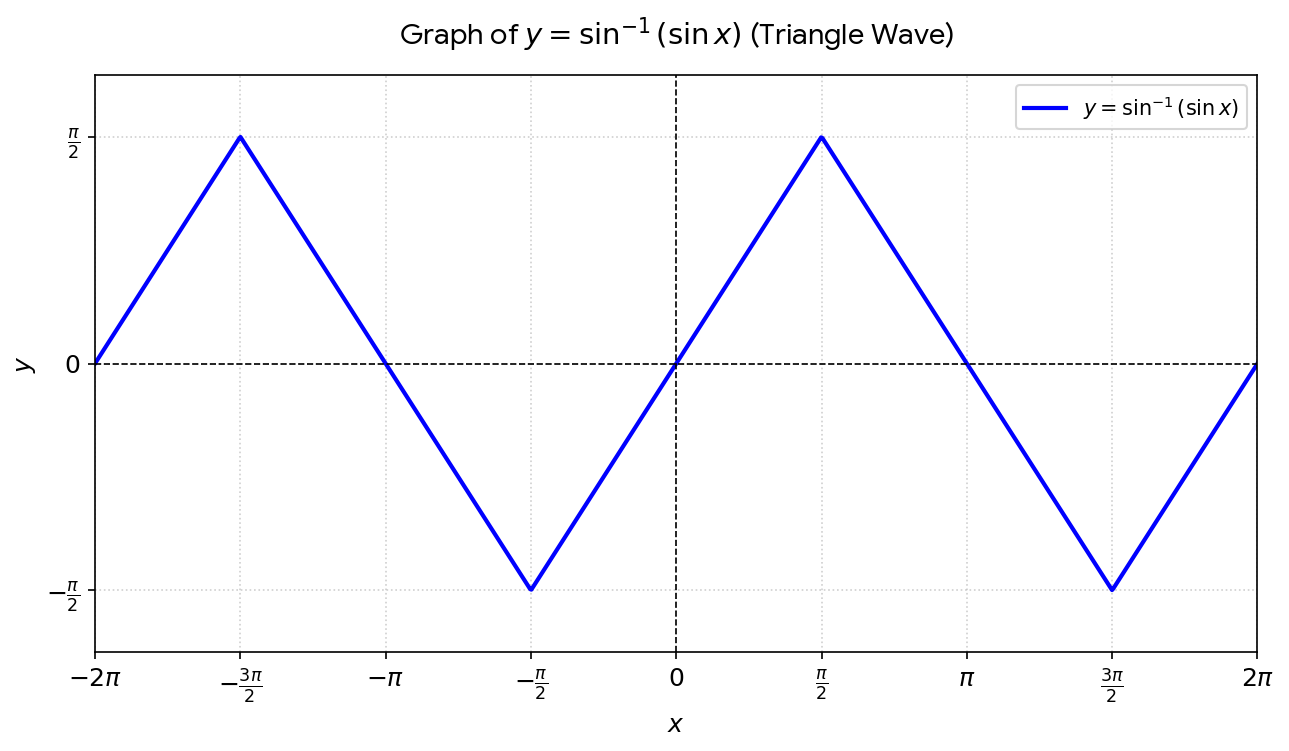
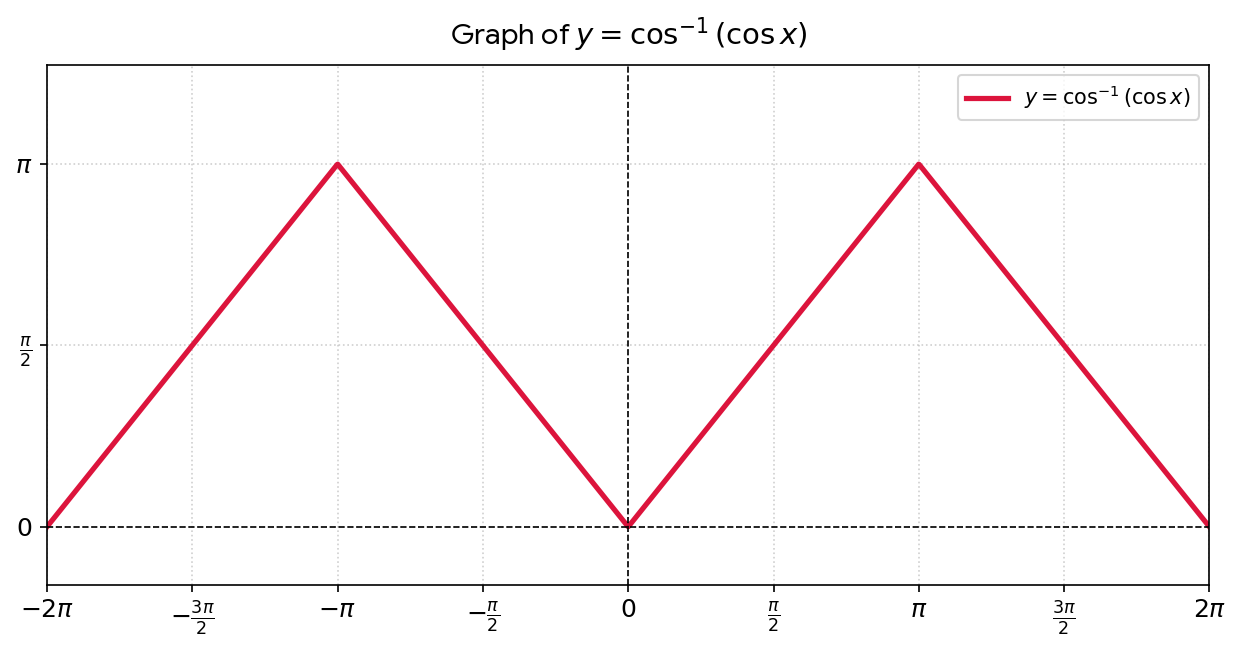
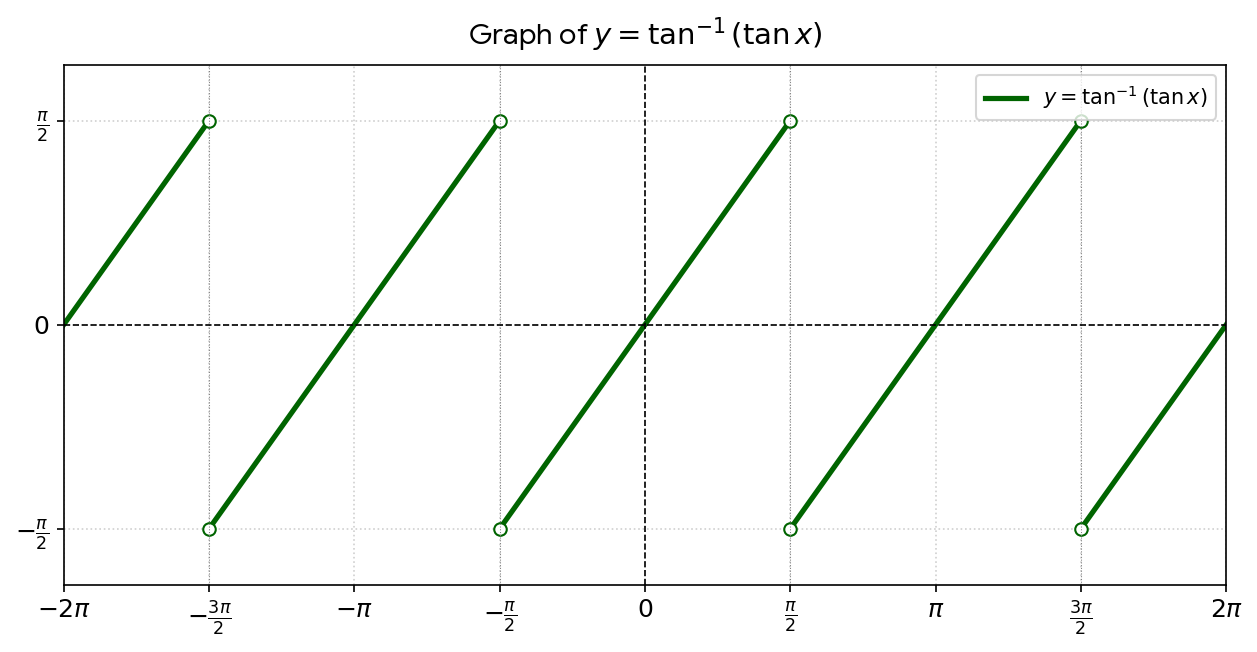
JEE Tip Graphs of Self-Inverse Compositions (Sawtooth & Triangle Waves)
These graphs are paramount for JEE Advanced area under curve and continuity/differentiability questions:
- : A continuous zig-zag (triangle wave) passing through the origin. Domain , Range . Period is . Slope is alternately and .
- : A continuous triangular wave starting at and peaking at . Domain , Range . Period is .
- : Parallel line segments of slope with points of discontinuity (open circles) at odd multiples of . Domain , Range . Period is .
04Formulae, Equations & Properties of ITF
All properties of inverse trigonometric functions are strictly valid only within their defined domains and principal value branches.
1. Self-Cancelling Properties
:
for
for
for
:
- for
- for
- for JEE Tip If is outside these principal intervals, use the periodic and symmetric properties of trigonometric functions to reduce the angle into the principal branch before cancelling.
2. Negative Argument Properties (Odd/Even Analogs)
- , for
- , for
- , for
- , for
- , for
- , for JEE Tip The adjustment for , and is heavily tested. Forgetting the leads to answers in the wrong quadrant.
3. Reciprocal Properties
- , for
- , for
- , for
- , for JEE Tip This split condition for based on the sign of is a notorious JEE trap!
4. Complementary Angles Properties
- , for
- , for
- , for
5. Sum and Difference Formulas
JEE Tip Always evaluate the product before applying these.
, if
, if
, if
if
- , if
- Applicable directly when and . If , subtract from .
- Applicable when .
6. Multiple Angle Formulas (Domain Restricted)
, valid for
, valid for
, valid for
, for
, for
, for
- , for
05Standard Derivations & Step-by-Step Problem Solving
Simplifying Complex Inverse Expressions
When simplifying expressions, use standard trigonometric substitutions:
- For , substitute or .
- For , substitute or .
- For , substitute or .
- For , substitute .
Example 1: Simplify for .
- Use half-angle identities: and .
- Substitute and factor: .
- Divide numerator and denominator by : .
- Recognize tangent addition formula: .
Example 2: Evaluate .
- Check bounds: .
- Use : .
- Since , .
Infinite Series Summation (Method of Differences)
JEE Tip For a series like , factor into the product of two terms such that their difference exactly matches the numerator . Then apply: . By summing, interior terms cancel out (telescoping series).
06Conditions & Limitations
- Non-algebraic Nature: . Inverse trigonometric functions are transcendental, not linear.
- Variable Bounds: Never manipulate an identity without checking the domain of the variable . For instance, writing outside is mathematically invalid and requires piecemeal branch adjustments (e.g., adding/subtracting ).
07COMMON MISCONCEPTIONS & SIGN CONVENTIONS
- Misconception regarding notation: Writing . Correct convention is .
- Assuming arbitrary cancellation: Expanding without verifying if .
- Negative variables inside radicals: When creating triangle reference diagrams from an inverse trigonometric expression (e.g., Let ), one often forgets that if , the values in other quadrants mandate specific sign corrections. JEE Tip Always evaluate the sign of the output directly based on the principal value range.
08Previous Year JEE Topics
- Roots of equations involving ITFs: Equating functions with different domains requires taking intersections of domains. (e.g., finding satisfying ).
- Telescoping Series of : Almost guaranteed to appear in JEE Advanced Paper 1 or 2 every alternate year.
- Calculus of ITFs: Limits and derivatives involving composite functions like at (It is non-differentiable here due to the sharp corner in the sawtooth graph).
- Integration of ITFs: Often requires integration by parts where the inverse function is set as the first function () according to the ILATE rule.
09JEE Traps
When solving , students often write . Remember the 'C' functions with range (i.e., ) pull out negatives as .
When and , is exactly , not undefined, even though the standard addition formula yields .
for any real number .
ONLY if . Outside this, you must fold the value back into the domain using or shifts.
under all conditions.
This only holds if . If and , you must add . If and , you must subtract .
for all .
This is only true for . If , .
Domain of an inverse trig function is the same as the original trig function.
The domain of an inverse trigonometric function is strictly the range of the originally restricted trigonometric function.
The range of is .
The range of is because is not defined.
Expanding automatically to .
It equals only when . For , it equals .
is the same as .
The former applies the square to the argument . The latter squares the angle outcome. They are entirely different functions.
If , the interval includes .
The principal value branch strictly removes because is undefined. The range is .
The limit applies for .
This limit is standard for . For , is fundamentally undefined because its domain is restricted to .
.
Since is outside , we evaluate . Then . The correct output is .